 Capamoon
The tools changed. Not how we work.
We've sharpened Capamoon's positioning and launched a new site. Here's why.
Hi,
We've just changed quite a few things at Capamoon: our offer, our site, the way we introduce ourselves. The goal: to make our value proposition clearer, at a time when technology is moving incredibly fast, and to reflect what's really at the core of what we do, which is how we actually work with companies.
In two years, our tools and the way we execute have changed radically. The way we think about projects hasn't. We decided to make that clearer in how we communicate.
We started out calling ourselves a no-code agency
Two years ago, the two of us launched, convinced we could solve concrete problems for SMBs with no-code. A few dozen projects later, no-code is still a relevant technology, but it isn't the core of our value proposition.
The trouble is that introducing yourself as “a no-code agency” means defining yourself by a tool. And the technology, even if it stays an important part of what we deliver, the client doesn't care about it (except for the geekiest among us). What interests them is the end result, meaning the business benefit.
What two years taught us
Nobody buys no-code from us. Or AI, for that matter.
What clients buy is something else: time saved, fewer errors, more flow and structure in their processes, a better experience for their teams and their clients, the ability to grow and, at the end of the chain, lower costs or more revenue.
We worked with a French renewable energy player. They didn't ask us for “a bot”. Their daily reality was declaring the output of their solar plants to EDF, one by one, on the energy provider's portal. Count 1 to 2 minutes per site, dozens of sites. Add the tracking of hundreds of invoices every month and the ENEDIS grid-connection files. Several days a month spent on admin tasks with no added value.
Their real question, behind the automation, was how to grow while keeping their headcount and costs under control, so they could focus on their core business instead of filling in forms. We started by identifying with them which processes to automate, to prioritize the biggest time savings, then put in place a monitoring system that checks the bots are running correctly and raises an alert when needed. Result: about 80% less admin time, data-entry errors that vanish, teams back to their real job (developing solar projects), and full control over the automation in place.
~80% less admin time
Data-entry errors that vanish, teams back to their real job.
We seek to understand first
Tech projects rarely fail because of technology. They fail because someone built a solution that misses the real needs and doesn't solve the real problem.
Most agencies pick the tools first, clients sometimes show up with a de facto solution in mind, and in the end it's easy to miss the real business requirements if you don't ask the right questions first.
An example. A health startup contacts us to manage its patients, practitioners, appointments and payments. The easy reflex would have been to pull out the tools right away. Except the real challenge wasn't technical: it needed a solution that held up to the confidentiality constraints of healthcare (health data is obviously highly sensitive) while staying usable day to day by teams who aren't engineers. So we started by defining the target processes, the regulatory obligations (the solution had to comply with HIPAA in the United States) and how each person interacts with whom. Once that base was laid, we built the solution, choosing no-code tools for the main building blocks (CRM, forms, automations) and Stripe for payment. AI let us write scripts for the automations where no-code hit its limits, as well as the integration between the CRM and Stripe. But it was the understanding of the business and the real constraints (cost, ease of adoption, complexity and regulatory compliance) that drove the technical choices.
Sometimes the problem is elsewhere. An endowment fund calls us because its tools, patched together over the years, have become unmanageable. We were considering switching no-code tools and “simply” reworking the existing automations. Except the real problem ran deeper. Their data model no longer matched the way they worked, and the technical solution had become hard to maintain, with the inconsistencies that come with that complexity. So we put the foundations back straight, meaning the data model, rethought the user journey (internal process and the associations' applications) and completely rebuilt the forms and automations. We kept the same no-code tools (Airtable, Jotform and Make), the ones the team already knew. And today, they run the tool on their own, without us. Once again, technical choices driven by business requirements.
AI is part of our production line
In our projects, we use AI in two ways. Sometimes, when it's relevant, as a component of the solution we deliver (a chatbot, document analysis, automatically generated responses), and always as part of our production line, which lets us go further and faster. It's this second way that has changed our work the most.
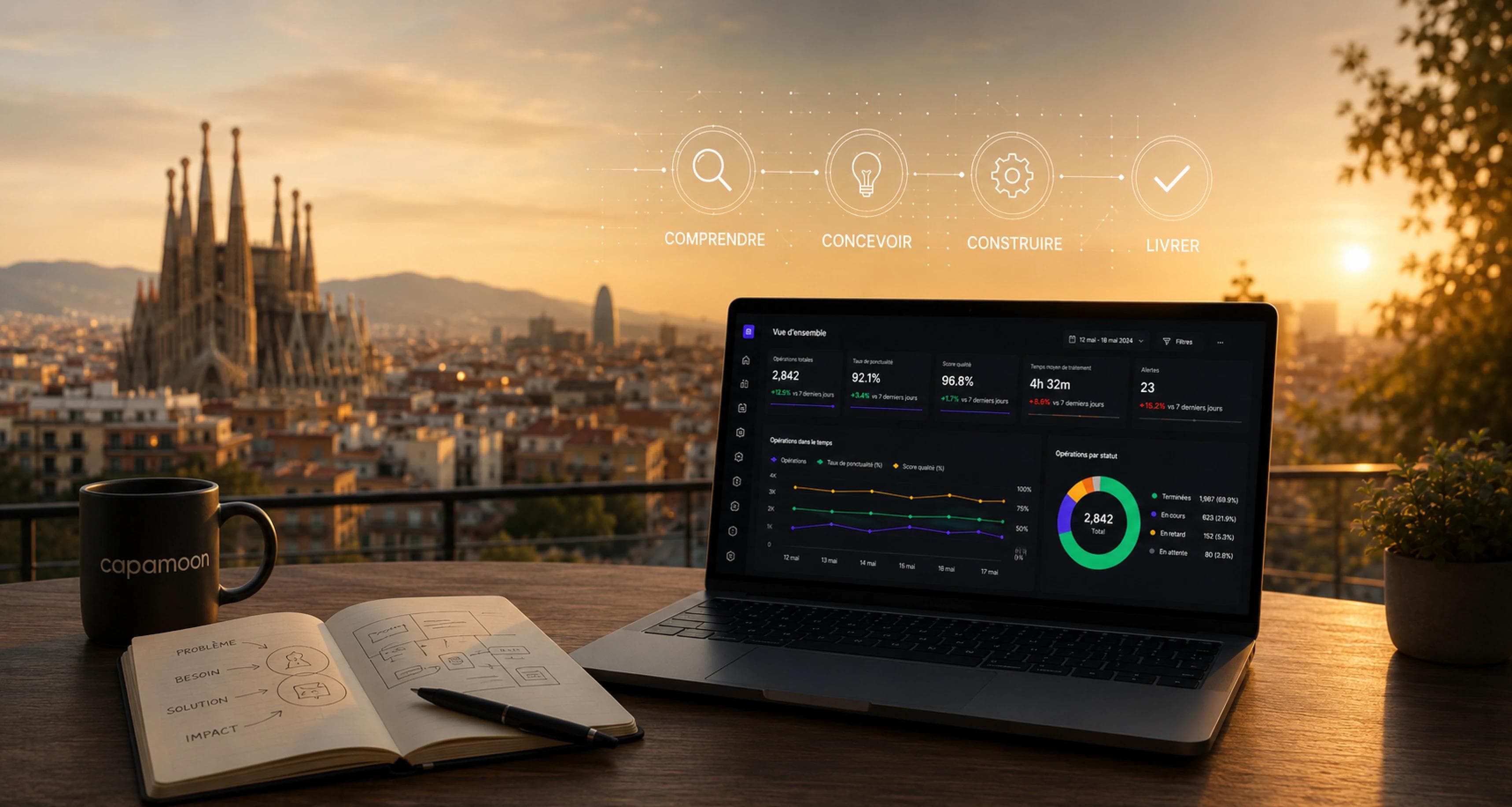
When a SaaS platform asked us for an analytics dashboard to steer its workflows, we combined the classic product approach (discovery, design, build, test, deployment) with AI, at every phase of the project.
In practice, we follow a spec-driven development logic: before writing a single line of code, we generate the specification documents with AI. First the PRD, the document that defines the functional needs and business rules, then the architecture and the implementation plan. We review them, we iterate on them. That's where human thinking is essential, because you have to make the right calls, both functional and technical. It's often intense and always fascinating.
Once the specs are solid, AI codes the dashboard based on them, following our guidelines (visual identity, code best practices). We also automate the tests, to avoid any regression with each new change.
The upshot: a complete, tested prototype in two weeks, where this kind of tool usually takes months.
A complete, tested prototype in two weeks
Where this kind of tool usually takes months.
A word of caution, though: AI doesn't replace judgment or thinking. It has its biases, it hallucinates, it can have a partial view of the context you operate in, and it knows nothing of what we've learned in the field over twenty years. That, too, is Product Thinking: we cross-check, we verify, we decide. In short, we make the synthesis to produce the best possible product. The product manager becomes the pilot and the controller, at every stage of building the solution.
Our new positioning
Product Thinking + AI-Powered Execution. Understand before you build, then execute fast thanks to AI. It's what we've done since day one. We just finally said it clearly, in our offer as well as on our new site.
“Product Thinking + AI-Powered Execution”
And while we're at it: this article is a good example. The thinking, the story, the convictions: written by hand, 100%. AI only stepped in afterward, to speed up what could be sped up: the translations and fixing the typos (who said we made any?). We told you. AI is everywhere, except in what matters most.
About the co-founders

Julien Andrieu
20 years of experience in Product Management and digital product development. After working in startups, SaaS vendors and international groups, he now helps SMBs design digital solutions built around real business needs.

Yahan Bermudez
An entrepreneur and 360 marketing specialist for more than 10 years, he has spent several years helping SMBs grow and optimize their operations. His approach combines business vision, pragmatic execution and measurable results.
Want to talk it over? Write to us: hello@capamoon.com
Or if you're in Barcelona, feel free to reach out for a coffee ☕